TL;DR
- On $150,000 in NYC, you keep about $100,121 a year, roughly $8,343 a month. Federal, state, city, and FICA grab $49,879. That’s a 33.3 percent effective rate before you’ve bought a single thing.
- New York City charges its own income tax: about $5,379. That’s on top of $8,291 to the state. NYC is one of the only American cities taxing your income just for the privilege of existing inside its borders.
- Albany quietly claws back about $481 through “recapture.” Once you clear ~$107,650, the state phases out the discount it gave you on the lower brackets. It’s real. It’s legal. It never shows up on a paystub.
- After a median 1-bedroom and the subway, you’re left with about $4,193 a month. Before food. Before utilities. Before one single drink. On a salary the city treats like Monopoly money.
You make $150,000 a year. That’s a massive salary almost anywhere else in America. In New York? It’s the baseline number where you can almost afford a one-bedroom and a MetroCard. Nothing else is promised.
Here’s where it actually goes.
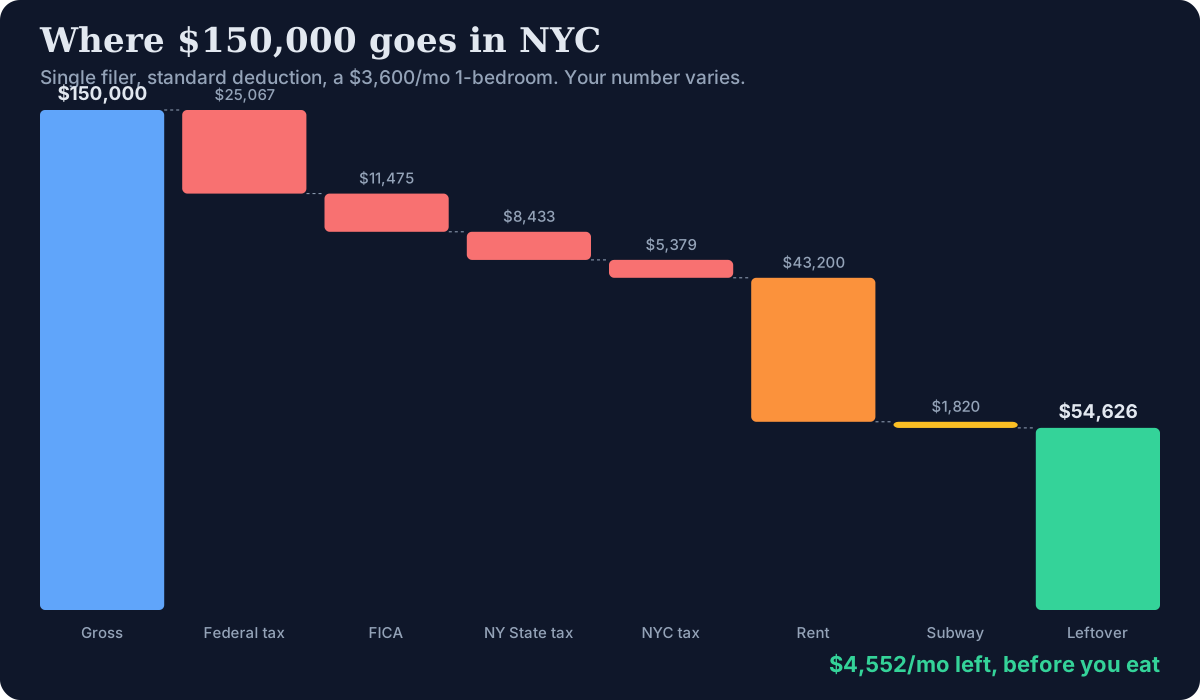
Before you make a single decision about your own money, the federal government, New York State, New York City, and payroll taxes take $49,879. That isn’t a loophole someone forgot to close. That’s the deal. Your effective tax rate is 33.3 percent. You keep 67 cents on the dollar.
Want the real money math on living in NYC?
Take-home pay, taxes, rent, and what a New York salary actually keeps. Free, every weekday.
Free. No spam. Unsubscribe anytime.
Where the $49,879 goes
Washington takes $24,734. Federal income tax on $150,000 after the standard deduction. Expected. Same in Tampa or Topeka. This part isn’t New York’s fault.
FICA takes $11,475. Social Security caps out at the $184,500 wage base, so you pay 6.2 percent on the whole thing. Medicare is another 1.45 percent with no cap. This funds programs you won’t touch for forty years. You can’t opt out.
New York State takes $8,291. Here’s where it gets local. The state’s top brackets are steep, but the part nobody warns you about is the recapture. Once you cross roughly $107,650, Albany starts undoing the discount it gave you on the lower brackets, dragging you toward a flat tax at your top rate. On $150k it costs you about $481 you’ll never see itemized. “Recapture” is a polite word for “we changed our minds about the parts that helped you.”
New York City takes $5,379. Then the city stacks its own income tax on top. Living here is a privilege you apparently pay rent on twice. Up to 3.876 percent, no separate deduction, skimmed off the exact same income the state already taxed. Move ten miles to New Jersey and this line goes to zero. That’s $448 a month you pay purely for a five-borough zip code.
The Leftover: NYC Real Living-Cost Worksheet
The exact math behind NYC take-home pay: federal, state, and city brackets, standard deductions, OMNY fare caps, and true leftover income by salary tier.
- NYC 3.876% resident tax bracket & recapture threshold tables
- Take-home pay calculation for $75k, $100k, $150k, $225k, and $250k
- Monthly rent vs. living expense budget template
The worksheet is a free page on this site. Subscribing also gets you the free NYC Daily TL;DR weekday briefing.
The median rent, and the Manhattan surcharge
Taxes leave you about $8,343 a month. Two bills land before you decide anything, and the first one is a fork in the road.
Rent: about $3,999.1 That’s the citywide median asking rent for a one-bedroom in August 2026, up from $3,750 in January. Not Tribeca. Not a doorman. The dead middle. The Manhattan median is $4,845, and paying it would erase about another $10,000 a year from the number below.
The subway: about $152. The base fare hit $3.00 on January 4, 2026. That same day, the MTA killed the 30-day unlimited MetroCard and replaced it with the OMNY cap: $35 a week, free after 12 rides. Annualized, you hand the MTA about $1,820 a year2 to stand in a hot tunnel waiting for a delayed train. It isn’t technically a tax. It just feels like one.
That leaves $4,193 a month. Before groceries. Before utilities. Before your health-insurance premium, your student loan, your gym, your phone, or one single drink at a bar charging $18 for it. On $150,000 a year. In the city that bills itself as the place you go to make it.
$150,000 is the band where the address stops being scenery and starts being a line item. The $3,999 is a citywide median, which is another way of saying it is largely an outer-borough number with a commute attached. Take the Manhattan median for the same one-bedroom, $4,845, and your leftover falls from $4,193 to about $3,347 a month. Call it roughly $10,000 a year for the borough. At $150,000 you can still choose to pay it, which is the part that separates this rung from the one below it.
Run the shares and you can see how tight the frame still is. Rent and the fare come to $4,151 a month, half of what you keep. The other half is everything else you will ever want, and Albany’s $481 recapture is already inside the tax number you started from. Nobody itemizes that for you.
$150k is not the number you think it is
The lesson isn’t that you’re poor. $4,193 a month of true discretionary cash is a real living, and most New Yorkers would take it in a heartbeat. The lesson is that the gap between the salary and the life is wider here than anywhere else in the country. The city engineers it that way. A resident income tax no other major metro charges. A state recapture that flattens your brackets the moment you start doing well. A rent floor turning a six-figure paycheck into careful-renter money.
If you want to understand why the bill is structured this way:
- The Leftover, by salary: what every NYC income keeps. Where $150k sits on the full ladder, from $90k to $250k.
- Why your property tax bill is so unequal. The same logic, applied to anyone who tries to buy instead of rent.
- How NYC actually spends the $115 billion it collects. Where the $5,379 you just paid the city goes.
- What you pay the MTA, and what it buys. The $1,820 fare, in context.
- How rent stabilization works. And why the median 1-bedroom costs what it does.
We computed the numbers above; we didn’t guess. Methodology: tax year 2026, single filer, standard deduction ($16,100 federal / $8,000 NY), no pre-tax 401(k) or health premiums, a $3,999/mo one-bedroom (the StreetEasy citywide median, August 2026), and the $35/week OMNY fare cap annualized. New York State tax includes the tax-table-benefit recapture above $107,650. It’s an estimate. Your exact number varies with your rent, your retirement contributions, and your filing status. But the shape doesn’t change. In New York, a third goes to tax before you even start. The city collects the rest the slow way.
Want the real money math on living in NYC?
Take-home pay, taxes, rent, and what a New York salary actually keeps. Free, every weekday.
Free. No spam. Unsubscribe anytime.
Footnotes
-
StreetEasy Data Dashboard, median asking rent for a one-bedroom, August 2026 (citywide $3,999; Manhattan $4,845). streeteasy.com/blog/data-dashboard ↩
-
MTA fare update, January 2026 ↩
Frequently asked questions
What is the take-home pay on a $150,000 salary in NYC?
About $100,121 a year, or roughly $8,343 a month, for a single filer taking the standard deduction. That is after $24,734 in federal income tax, $11,475 in FICA (Social Security and Medicare), $8,291 in New York State income tax, and $5,379 in New York City resident income tax. Total tax: $49,879, an effective rate of 33.3 percent. You keep about 67 cents on the dollar before you have paid for anything.
What is the effective tax rate on $150,000 in New York City?
About 33.3 percent, combining federal income tax, FICA, New York State income tax, and the New York City resident income tax. That is the all-in effective rate on gross wages for a single filer with the standard deduction. The marginal rate on the next dollar is higher: about 42.6 percent once federal, state, city, and FICA stack, and about 35 percent in income tax alone.
How much is NYC income tax on a $150,000 salary?
About $5,379 in New York City resident income tax, on top of $8,291 in New York State tax. NYC is one of the few U.S. cities that levies its own income tax on residents, charging up to 3.876 percent. It has no separate standard deduction; it taxes the same income base as the state. For a $150k single filer that city tax alone is roughly $448 a month skimmed off the top for the privilege of living inside the five boroughs.
What is New York's tax-table-benefit recapture?
Above roughly $107,650 of income, New York stops taxing you on a purely graduated basis and starts clawing back the benefit of the lower brackets, phasing you toward a flat tax at your top rate. It is called the tax-table-benefit recapture. For a single filer at $150,000 it adds about $481 of state tax that never appears as a line item on a paystub. It is real, it is in the IT-201 instructions, and almost nobody budgets for it.
Can you live comfortably on $150,000 in New York City?
You can live, but $150,000 is not the comfort number it sounds like. After taxes you keep about $8,343 a month. A median NYC one-bedroom now asks about $3,999 and the OMNY fare cap costs about $152 a month, leaving roughly $4,193 before food, utilities, health premiums, student loans, or savings. It is a solid living, and it is renting-and-careful money.
How much does the subway cost per month in NYC in 2026?
Up to about $152 a month for a daily commuter. The base fare rose to $3.00 on January 4, 2026. The 7-day and 30-day unlimited MetroCards were discontinued the same day; the OMNY system now caps fares at $35 per 7-day window, with rides free after 12 paid trips. Annualized, a capped commuter pays about $1,820 a year to ride.