TL;DR
- On $250,000 in NYC, you keep about $157,980 a year, roughly $13,165 a month. Federal, state, city, and FICA take $92,020. That is a 36.8 percent effective rate before you have bought a thing.
- New York City charges its own income tax: $9,255. On top of $15,947 to the state. NYC is one of the only American cities that taxes your income for the privilege of living here, and at $250k it charges you more than some people’s rent.
- Albany’s recapture is working overtime on your bracket. Once you cleared $107,650, the state started clawing back the discount it gave you on the lower brackets. At $250,000 you are deep inside the recapture zone, and you will never see it as a line item.
- After a Manhattan 1-bedroom and the subway, you are left with $8,168 a month. Before groceries, utilities, health premiums, or one single $18 bar tab. A quarter-million dollars a year, and the city still has its hand in your pocket on the way out.
You make $250,000 a year. That is the number people say out loud with a slight pause, the one that’s supposed to mean you’ve figured it out. In New York City it means you can afford a decent one-bedroom, a subway card, and a continuous low-grade anxiety about your savings rate.
Here is where it actually goes.
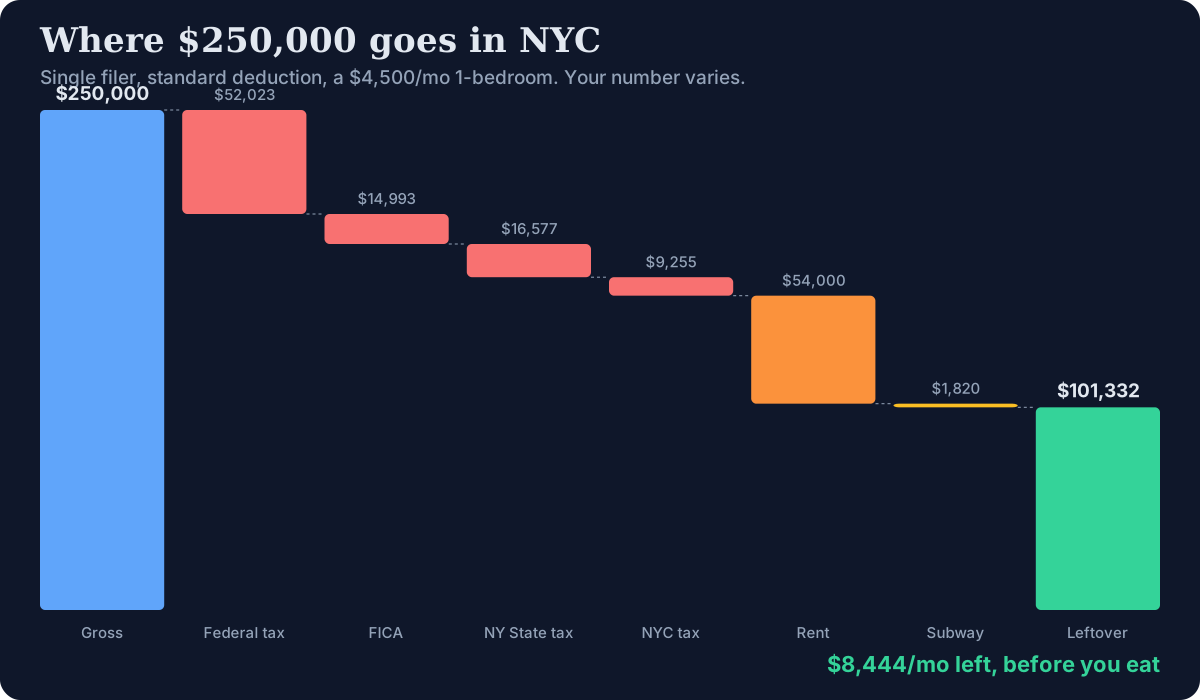
Before you have made a single choice about your own money, the federal government, New York State, New York City, and payroll taxes have taken $92,020. Not a rounding error. Not a loophole you missed. The deal. Your effective tax rate is 36.8 percent, and you keep about 63.2 cents on every dollar you earned.
Want the real money math on living in NYC?
Take-home pay, taxes, rent, and what a New York salary actually keeps. Free, every weekday.
Free. No spam. Unsubscribe anytime.
Where the $92,020 goes
Washington takes $51,304. Federal income tax on $250,000 after the standard deduction. Steep, yes, but Tampa pays this too. This is the part you share with the rest of the country. It is the New York layers underneath that make the number uniquely punishing.
FICA takes $15,514. Three bites: Social Security at $11,439, standard Medicare at $3,625, and the Additional Medicare surcharge, the one that kicks in above $200,000 for single filers, at $450. That last piece is new enough that plenty of people miss it in their mental math. You cannot opt out of any of it, and the benefits are forty years away.
New York State takes $15,947. This is where the geography starts costing you real money. The state brackets are aggressive, but the part that does the quiet damage is the recapture. New York phases out the benefit of the lower brackets once you cross roughly $107,650, dragging your effective rate upward toward your top marginal rate. At $250,000 the state has already taken back the whole discount on every bracket below 5.9 percent, and it is 69 percent of the way through taking back the discount on the 5.9 percent bracket itself. That is about $1,984 of the $15,947. It never shows up as a separate line on your paystub, which is exactly how Albany prefers it.
New York City takes $9,255. Then the city adds its own resident income tax on top, because the state wasn’t enough. Up to 3.876 percent, no separate deduction, applied to the same income Albany already taxed. Move to Jersey City and this line goes to zero. Stay here and it costs you roughly $771 a month, every month, simply for living inside the five boroughs. The Rent Guidelines Board sets your rent. The tax code sets your other rent.
Want the real money math on living in NYC?
Take-home pay, taxes, rent, and what a New York salary actually keeps. Free, every weekday.
Free. No spam. Unsubscribe anytime.
$58,140 a year for somewhere to sleep
Taxes leave you $13,165 a month. At this salary the two fixed bills stop being the thing that limits you, which turns out to be its own kind of bad news.
Rent: $4,845 a month.1 That is the median asking rent for a Manhattan one-bedroom in August 2026, up from $4,525 in January. Annualized, you hand your landlord $58,140. The Rent Guidelines Board sets allowable increases for stabilized units. This one is not stabilized.
The subway: about $152 a month.2 The base fare hit $3.00 on January 4, 2026. The same day, the MTA retired the 30-day unlimited MetroCard and replaced it with the OMNY fare cap: $35 a week, free after 12 rides in a 7-day window. Annualized, you pay the MTA $1,820 a year to stand on a platform in a tunnel that smells like a policy failure. The FARE Act capped the weekly outlay. The MTA found other ways to close the gap.
That leaves $8,168 a month. Before groceries. Before utilities. Before the health-insurance premium your employer may or may not cover, the student loan the federal government is still deciding what to do with, the gym, the phone, or the drink you need after looking at this spreadsheet.
Here is the inversion that defines this band. Rent and the fare together come to $4,997 a month, about 38 percent of what you keep. Housing has stopped being the constraint. The tax bill has become it: $92,020 in tax against $58,140 in rent, a gap of $33,880. Somewhere on the way up this ladder your largest annual expense quietly stopped being the roof over your head and became the government, and no one sends a notice when it happens.
Which is why the $250,000 complaint is a different complaint. At the bottom of the ladder you argue with a landlord. Here you are arguing with Albany and City Hall, and the $771 a month the city alone takes is more than five times what you pay to ride the subway. Neither number is negotiable, and only one of them comes with a train.
$250k is not the number you think it is
The lesson is not that you are struggling. $8,168 a month of true discretionary income is a genuinely good New York life, and the vast majority of this city would trade places without hesitating. The lesson is that the gap between the salary and the life is structural and deliberate: a city income tax that no comparable American metropolis charges, a state recapture mechanism that quietly flattens your brackets the moment you start doing well, a rent floor that converts a quarter-million-dollar salary into careful-renter-who-probably-can’t-buy money, and a transit fee that is technically optional until it isn’t.
New York collects $92,020 from you before you pay for anything. Then it charges you $58,140 for a place to sleep. The $8,168 that remains is not a leftover. It is what the city decided you get to keep.
To understand how these policies are set:
- How The Leftover math works on $150,000. The same calculation, one bracket down, and the comparison is illuminating.
- Why your property tax bill is so unequal. The same logic applied to anyone trying to buy instead of rent.
- What you pay the MTA, and what it buys. The $1,820 fare, in full context.
Methodology: tax year 2026, single filer, standard deduction ($16,100 federal / $8,000 NY), no pre-tax 401(k) or health premiums, a $4,845/mo 1-bedroom (the StreetEasy Manhattan median, August 2026), and the $35/week OMNY fare cap (annualized). NY State tax includes the tax-table-benefit recapture that phases out the lower-bracket benefit above $107,650 (single). An estimate; your number varies.
Want the real money math on living in NYC?
Take-home pay, taxes, rent, and what a New York salary actually keeps. Free, every weekday.
Free. No spam. Unsubscribe anytime.
Footnotes
-
StreetEasy Data Dashboard, median asking rent for a one-bedroom, Manhattan, August 2026. streeteasy.com/blog/data-dashboard ↩
-
MTA fare update, January 2026 ↩
Frequently asked questions
What is the take-home pay on a $250,000 salary in NYC?
About $157,980 a year, or roughly $13,165 a month, for a single filer taking the standard deduction. That is after $51,304 in federal income tax, $15,514 in FICA (Social Security, Medicare, and Additional Medicare), $15,947 in New York State income tax, and $9,255 in New York City resident income tax. Total tax: $92,020, an effective rate of 36.8 percent. You keep about 63 cents on the dollar before you have paid for anything.
What is the effective tax rate on $250,000 in New York City?
About 36.8 percent, combining federal income tax, FICA, New York State income tax, and the New York City resident income tax. That is the all-in effective rate on gross wages for a single filer with the standard deduction. The marginal rate on the next dollar is higher, stacking city, state, and federal brackets on top of one another.
How much is NYC income tax on a $250,000 salary?
About $9,255 in New York City resident income tax, on top of $15,947 in New York State tax. NYC is one of the few U.S. cities that levies its own income tax on residents, charging up to 3.876 percent. It has no separate standard deduction; it taxes the same income base as the state. For a $250k single filer that city tax alone is roughly $771 a month paid purely for the privilege of a five-borough address.
What is New York's tax-table-benefit recapture and how does it affect a $250,000 earner?
Above roughly $107,650 of income, New York stops taxing you on a purely graduated basis and starts clawing back the benefit of the lower brackets, phasing you toward a flat tax at your top rate. It is called the tax-table-benefit recapture. At $250,000 you are deep in the recapture zone, and the effect is baked into the $15,947 state tax figure. It never appears as a line item on your paystub. It is real, it is in the IT-201 instructions, and it costs you more than most people at this income realize.
Can you live comfortably on $250,000 in New York City?
You can live well, but $250,000 is not the wealth number it sounds like. After taxes you keep about $13,165 a month. The median Manhattan one-bedroom asks about $4,845 a month and the OMNY fare cap costs about $152 a month, leaving roughly $8,168 before food, utilities, health premiums, student loans, or savings. It is a genuine upper-middle-class living, but it is still renting-carefully money.
How much does the subway cost per month in NYC in 2026?
Up to about $152 a month for a daily commuter. The base fare rose to $3.00 on January 4, 2026. The 7-day and 30-day unlimited MetroCards were discontinued the same day; the OMNY system now caps fares at $35 per 7-day window, with rides free after 12 paid trips. Annualized, a capped commuter pays about $1,820 a year to stand in a hot tunnel waiting for a delayed train.