TL;DR
- On $90,000 in NYC, you keep about $64,815 a year, roughly $5,401 a month. Federal, state, city, and FICA take $25,185. That is a 28.0 percent effective rate before you have bought a single thing.
- New York City charges its own income tax: $3,053. On top of $4,271 to the state. Nearly every other American city lets that slide. This one does not.
- After an outer-borough 1-bedroom and the subway, you are left with $2,225 a month. Before food, before utilities, before anything breaks, before a single decision you actually chose.
- $90,000 sounds like real money. In New York it is a careful budget. The gap between the salary and the life is the whole story of this city, and the math does not flatter it.
You make $90,000 a year. In most of the country that is a comfortable living. In New York it is the number where you can rent a decent outer-borough one-bedroom, swipe your MetroCard, and arrive at the end of the month with $2,225 left. Everything else is a negotiation with the calendar.
Here is where it actually goes.
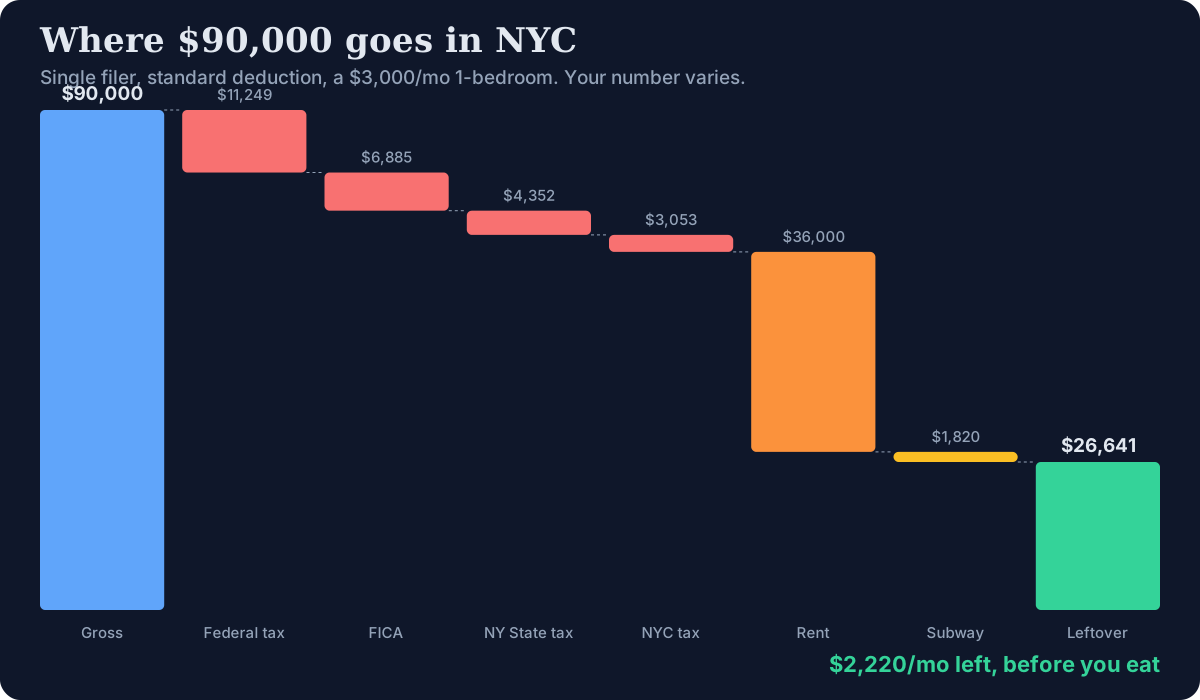
Before you have touched your money, the federal government, New York State, New York City, and the payroll-tax apparatus have taken $25,185. That is not a fluke. That is the agreed-upon arrangement. Your effective tax rate is 28.0 percent, and you keep about 72 cents on every dollar you earned.
Want the real money math on living in NYC?
Take-home pay, taxes, rent, and what a New York salary actually keeps. Free, every weekday.
Free. No spam. Unsubscribe anytime.
Where the $25,185 goes
Washington takes $10,976. Federal income tax on $90,000 after the standard deduction. This is the part that is the same in Des Moines and Denver. New York did not invent it. It is the baseline cost of earning a salary in America.
FICA takes $6,885. Social Security takes 6.2 percent on wages up to the cap. Medicare takes 1.45 percent with no ceiling. Together that is $6,885 out of every paycheck, funding programs you will reach decades from now and cannot defer or negotiate. No exemptions. No appeal.
New York State takes $4,271. Here is where it gets local. The brackets climb fast, and the relevant thing to know at $90,000 is what is coming: earn about $18,000 more and the state begins its recapture, quietly undoing the discount it gave you on the lower brackets and dragging you toward a flat tax at your top rate. At $90k you are not there yet. But the meter is running. Right now the state takes $4,271, with no visible line item explaining exactly how it arrived at that number.
New York City takes $3,053. And then the city adds its own income tax on top of all of that, because the state tax was apparently insufficient as a statement. Up to 3.876 percent, levied on the same income Albany already taxed, with no separate standard deduction to soften it. Cross the Hudson into Jersey and this line disappears entirely. Stay here and it costs you roughly $254 a month just for the zip code.
Want the real money math on living in NYC?
Take-home pay, taxes, rent, and what a New York salary actually keeps. Free, every weekday.
Free. No spam. Unsubscribe anytime.
Rent takes 40 percent of the gross
Taxes leave you $5,401 a month. Then the two fixed costs arrive, and they are not optional.
Rent: $3,025.1 That is the Queens median asking rent for a one-bedroom in August 2026, which sits between the Bronx at $2,865 and Brooklyn at $3,695. Call it a typical outer-borough one-bedroom: a normal apartment in a normal neighborhood in the part of New York where people who earn $90,000 actually live. The Rent Guidelines Board sets limits on stabilized units and then sets them a little higher every year anyway. The open-market units do not ask permission. Annualized, this is $36,300, just over 40 percent of your gross salary. The standard New York screen asks for annual income of 40 times the monthly rent, which for this apartment is $121,000. On $90,000 you fail it, so you need a guarantor or a landlord willing to bend.
The subway: $152 a month. The base fare is $3.00. The 30-day unlimited MetroCard is gone. In its place: the OMNY cap, $35 per 7-day window, rides free after 12 paid trips. Annualized, a capped commuter sends the MTA $1,820 a year2 for the privilege of a service that is perpetually underfunded, perpetually delayed, and perpetually in the middle of a fare restructuring that somehow always ends with you paying more. The fare does not scale with your salary. At $90,000 it is 2.8 percent of everything you keep, and it is the identical $35 for the person in the next seat earning triple.
That leaves $2,225 a month. That is the leftover. Before groceries. Before a utility bill. Before the health-insurance premium, the student loan, the phone plan, the one dinner out that costs what it costs in this city. On $90,000 a year, in the borough you chose because Manhattan was not something you were going to discuss seriously.
Now look at the ratio, because it is the thing that makes this band different from every band above it. Rent and the fare together run $3,177 a month, about 59 percent of what survives the tax bill. And the $36,300 you hand your landlord over the year is larger than the entire $25,185 that federal, state, city, and payroll tax took combined. At $90,000 in New York, the tax code is not your biggest creditor. Your lease is.
That is also why the escape hatch is narrower than it looks from here. A raise does not move the $3,025 rent and it does not move the $152 fare. It does move you toward $107,650, about $18,000 up the ladder, where the state’s recapture switches on and starts taking a steeper cut of every new dollar before it ever reaches those same two bills.
$90k is not the number you think it is
The point is not that you are struggling. $2,225 of actual discretionary cash each month is real money, and plenty of New Yorkers would take that trade. The point is that the salary that sounds like arrival is, in New York, the salary where you have just covered the basics. A municipal income tax that few other American cities charge, a state recapture tax that ramps up as soon as you earn more, and a steep rent floor: these are the basic realities of what it costs to live here.
If you want to understand why the bill is built this way:
- The Leftover, by salary: what every NYC income keeps. The full ladder from $90k to $250k, side by side.
- What $150k actually keeps after taxes and rent. The next rung up, and how much better it actually gets.
- Why your property tax bill is so unequal. The same logic, for anyone considering buying instead of renting.
- What you pay the MTA, and what it buys. The $1,820 fare, in context.
- How rent stabilization works. And why the typical outer-borough one-bedroom costs exactly what it does.
Methodology: tax year 2026, single filer, standard deduction ($16,100 federal / $8,000 NY), no pre-tax 401(k) or health premiums, a $3,025/mo 1-bedroom (the StreetEasy Queens median, August 2026), and the $35/week OMNY fare cap (annualized). NY State tax includes the tax-table-benefit recapture that phases out the lower-bracket benefit above $107,650 (single). Federal tax comes from the IRS Tax Table, which applies below $100,000 of taxable income. Each figure is rounded to the dollar on its own, so a sum can be off by $1. An estimate; your number varies.
Want the real money math on living in NYC?
Take-home pay, taxes, rent, and what a New York salary actually keeps. Free, every weekday.
Free. No spam. Unsubscribe anytime.
Footnotes
-
StreetEasy Data Dashboard, median asking rent for a one-bedroom, August 2026 (Queens $3,025; Brooklyn $3,695; the Bronx $2,865). streeteasy.com/blog/data-dashboard ↩
-
MTA fare update, January 2026 ↩
Frequently asked questions
What is the take-home pay on a $90,000 salary in NYC?
About $64,815 a year, or roughly $5,401 a month, for a single filer taking the standard deduction. That is after $10,976 in federal income tax, $6,885 in FICA (Social Security and Medicare), $4,271 in New York State income tax, and $3,053 in New York City resident income tax. Total tax: $25,185, an effective rate of 28.0 percent. You keep about 72 cents on the dollar before you have paid for anything.
What is the effective tax rate on $90,000 in New York City?
About 28.0 percent, combining federal income tax, FICA, New York State income tax, and the New York City resident income tax. That is the all-in effective rate on gross wages for a single filer with the standard deduction. The marginal rate on the next dollar is higher, once city, state, and federal brackets stack.
How much is NYC income tax on a $90,000 salary?
About $3,053 in New York City resident income tax, on top of $4,271 in New York State tax. NYC is one of the few U.S. cities that levies its own income tax on residents, charging up to 3.876 percent. It has no separate standard deduction; it taxes the same income base as the state. For a $90k single filer that city tax alone is roughly $254 a month skimmed off the top for the privilege of a five-borough zip code.
What is New York's tax-table-benefit recapture and does it affect a $90,000 salary?
Above roughly $107,650 of income, New York stops taxing you on a purely graduated basis and starts clawing back the benefit of the lower brackets, phasing you toward a flat tax at your top rate. At $90,000 you are below that threshold, so the recapture does not hit you yet. That changes fast: a raise of roughly $18,000 triggers it, and it never appears as a line item on your paystub when it does.
Can you live comfortably on $90,000 in New York City?
That depends on your definition of comfortable. After taxes you keep about $5,401 a month. A typical outer-borough one-bedroom runs about $3,025 and the OMNY fare cap costs about $152 a month, leaving roughly $2,225 before food, utilities, health premiums, student loans, or savings. It is a livable number on a tight budget with no room for surprises.
How much does the subway cost per month in NYC in 2026?
Up to about $152 a month for a daily commuter under the OMNY fare cap. The base fare is $3.00. The OMNY system caps fares at $35 per 7-day window, with rides free after 12 paid trips in that window. Annualized, a capped commuter pays about $1,820 a year to stand on a platform waiting for a train that is running with delays.